Your Agent Said to Hold It Long Enough. For 9 in 10 Sellers at Marina Bay Suites, 14 Years Was Not Long Enough.
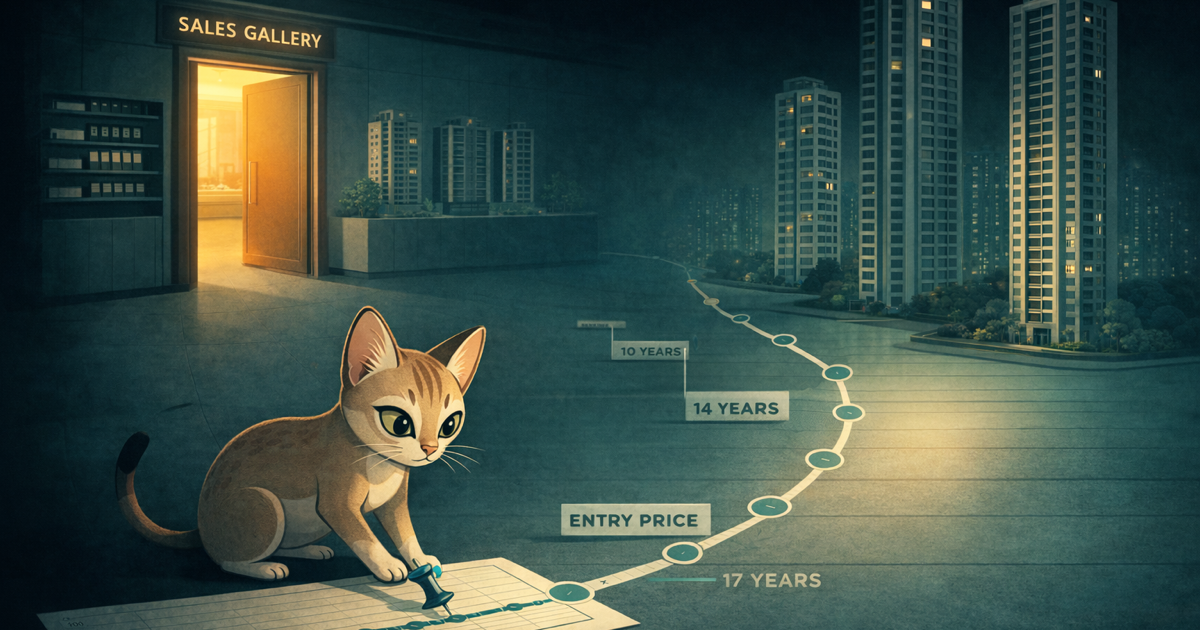
Everyone has heard the claim. A friend who bought in 2012 and sold last year for a decent gain. A parent who says property always goes up if you wait. An agent who tells you the entry price doesn't matter as much as the holding period.
The idea is simple: buy a new launch condo, hold it long enough, and time will take care of the rest.
For most buyers in most parts of Singapore, this claim has held up. But there is a specific group of buyers for whom it has not — and after 10 to 17 years, the clock is still running.
Sellers at Marina Bay Suites have held for an average of 14 years. Nine out of ten are still selling for less than they paid — with a typical shortfall of $512,000.
That is the puzzle this article will investigate. Not whether the claim is true or false, but when it is true and when it is not — and what separates the buyers who recovered from the ones who are still waiting.
The Investigation: Three Explanations for Why It Breaks
Before looking at the data, there are three competing explanations for why some buyers never recover:
Explanation 1: It is a region problem. CCR is more volatile than OCR and RCR. Buyers who bought in Districts 1, 9, and 10 face a fundamentally different resale market.
Explanation 2: It is a product problem. Marina Bay Suites, Marina One Residences, and Scotts Square are niche luxury products with a narrow resale pool. The losses reflect thin liquidity, not CCR broadly.
Explanation 3: It is an entry-price problem. These projects launched at a PSF so far above where the broader market eventually settled that no realistic holding period could close the gap — not 10 years, not 15.
The data allows us to test all three.
Where the Claim Holds — and Strongly
Start with OCR, because the results are unambiguous.
Sellers at Sol Acres in Choa Chu Kang District 23 — 158 transactions, the largest OCR sample — recorded a 100% win rate over an average 7.7-year hold, with a typical profit of $581,500 and a typical return of +85.8%. Every single seller made money.
Caspian in Jurong West District 22 has 34 transactions with an 11.7-year average hold, a 100% win rate, and a typical profit of $865,000. An OCR launch from before 2010, bought at a low PSF base, and carried upward by a decade of broad market appreciation.
The Centris, also in Jurong West, shows a 97% win rate across 39 transactions, with a typical profit of $820,000 over a 9.8-year average hold.
Even Kingsford Waterbay in Hougang District 19, a more recent launch, shows a 94% win rate across 143 transactions with a typical profit of $142,000 over 7.1 years.
In the RCR, Parc Esta in Geylang District 14 — 236 transactions, the largest RCR sample — shows a 100% win rate, typical profit of $397,500, and an annualised return of +5.4% per year over 5.5 years. It launched around 2018–2019, after the ABSD cooling measures had pulled prices back from earlier peaks. The Interlace in District 4 shows a 95% win rate and typical profit of $643,700 across 81 transactions over 9.4 years.
For these buyers, the claim is not just true — it is convincing. Buy, hold seven to twelve years, sell. The data says you almost certainly made money.
Where It Held, But Barely — The Borderline
Not all RCR stories are this clean.
Reflections at Keppel Bay in District 4 has 118 transactions and an average holding period of 10.7 years. Its win rate is 51%. The typical profit is $8,150.
After a decade of holding a flagship waterfront development in Bukit Merah, the median seller made roughly enough to cover one month's maintenance fees.
The wide spread — PSF ranging from $1,405 to $2,193 — suggests the outcome was heavily driven by which unit you bought and what you paid. Buyers who entered at the lower PSF end likely did fine. Buyers who paid the premium at the high end are almost certainly still underwater. Reflections launched around 2006–2007, at a price point that reflected peak enthusiasm for the Sentosa Cove–adjacent waterfront narrative. That narrative eventually faded.
Corals at Keppel Bay, also in District 4, shows a 44% win rate across 32 transactions after an average 8.3-year hold. The typical return is essentially zero. Slightly more than half the sellers lost money.
The Crest in District 3 is more positive — 60% win rate, typical profit of $68,000 over 7.5 years — but the margin is thin for a 7.5-year hold. An annualised return of +0.6% per year, nominal and before any opportunity cost.
| Project | District | Completed | Typical hold | Win rate | Typical return | Typical profit/loss | Transactions |
|---|---|---|---|---|---|---|---|
| Reflections at Keppel Bay | D4 | 2011 | 10.7 yrs | 51% | +0.3% | +$8,150 | 118 |
| Corals at Keppel Bay | D4 | 2016 | 8.3 yrs | 44% | −0.5% | $0 | 32 |
| The Crest | D3 | 2017 | 7.5 yrs | 60% | +3.4% | +$68,000 | 47 |
These RCR buyers who launched at cycle peaks ended up with coin-flip outcomes after nearly a decade. The margin between breaking even and losing money was determined largely by entry price within the same project — not by the region or the holding period.
The CCR Counter-Case: D'Leedon
Before examining the clearest claim-breakers, one CCR project needs to be named here — because it complicates a blanket "CCR is bad" reading.
D'Leedon in District 10 Bukit Timah has 122 transactions — the largest CCR sample — an average holding period of 9.6 years, a 96% win rate, and a typical profit of $644,444. Nearly every seller made money, with a typical return of +30.6%.
D'Leedon is CCR. Yet its result looks closer to an OCR success story than to Marina Bay Suites.
The difference is not region — it is entry price. D'Leedon launched at a lower PSF than the Downtown Core luxury projects, giving buyers enough headroom for the market to catch up and then exceed their entry cost. Explanation 1 — "it is a region problem" — does not survive D'Leedon.
Where the Claim Breaks Completely
Now the harder data.
| Project | District | Completed | Typical hold | Win rate | Typical return | Typical profit/loss | Transactions |
|---|---|---|---|---|---|---|---|
| Marina Bay Suites | D1 | 2013 | 13.6 yrs | 10% | −13.8% | −$512,000 | 20 |
| Scotts Square | D9 | 2011 | 14.4 yrs | 18% | −17.4% | −$669,290 | 17 |
| OUE Twin Peaks | D9 | 2015 | 7.9 yrs | 7% | −15.4% | −$380,000 | 43 |
| Marina One Residences | D1 | 2017 | 7.0 yrs | 4% | −13.4% | −$282,800 | 56 |
| V On Shenton | D1 | 2017 | 9.4 yrs | 24% | −3.8% | −$55,000 | 33 |
Note: Launch years for all CCR projects are inferred from completion year minus an estimated construction period of roughly three years. The conclusions rest on the difference between what buyers paid and what they sold for — not on a comparison to confirmed URA launch records.
Marina Bay Suites has the longest average holding period in the entire dataset: 13.6 years. Nine out of ten sellers are still selling for less than they paid. The typical shortfall is $512,000. This is a freehold-adjacent, iconic bayfront address in District 1. If the claim were simply about time, 14 years should be enough to recover almost anything.
Scotts Square is even more striking for a different reason. It is freehold. It sits in Orchard. If any combination of property fundamentals should guarantee eventual recovery — freehold tenure, prime location, central Singapore — it is this one. After an average holding period of 14.4 years, 82% of sellers are still underwater, with a typical loss of $669,290.
OUE Twin Peaks in River Valley District 9 has 43 transactions — a more robust sample — and a 7% win rate after an average 7.9-year hold. Only 3 of 43 sellers made money.
Marina One Residences has the largest sample of the loss-leaders: 56 transactions. The win rate is 3.6% — essentially nobody broke even. After seven years, the typical seller at Marina One lost $282,800.
Does holding longer fix it? The data suggests not. The projects with the longest average holds — Marina Bay Suites at 13.6 years, Scotts Square at 14.4 years — show the worst loss rates, not improving ones. The clock is not converging toward recovery. It is simply running longer while sellers remain underwater.
What Actually Separates Winners from Losers
This is where the three explanations from the opening can be assessed.
Explanation 1 — It is a region problem. Partially true, but D'Leedon breaks it. A CCR buyer who entered at moderate PSF in District 10 did well. The region alone does not determine the outcome.
Explanation 2 — It is a product problem. Worth taking seriously. Marina Bay Suites, Marina One Residences, and Scotts Square are all high-concept, landmark-adjacent, or niche products — smaller resale pools, fewer comparable transactions, buyers with very specific requirements. The thin resale market for luxury product may suppress recoverable prices. OUE Twin Peaks with 43 transactions and a 7% win rate is the best test of this: it is a recognisable but not uniquely niche product, and the results are almost identical to the more unusual developments. Product type contributes, but it does not explain everything.
Explanation 3 — It is an entry-price problem. This is the explanation with the most consistent support across all the data. The projects that failed were priced so far above where the broad market eventually settled that even a 33% nominal uplift in the URA Non-Landed Private index from 2021 to 2026 could not close the gap. The URA index rose from 158.8 in mid-2021 to 210.8 in early 2026 — a real and meaningful rise. It was not enough to rescue buyers who paid $3,200+ per sqft for Scotts Square or $2,300+ per sqft for OUE Twin Peaks at a 2012–2013 market peak.
The pattern that holds consistently: when the launch PSF was close to or below the long-run clearing price for that area, buyers recovered. When the launch PSF was so far above it that the market would need to grow into the price — and never did — buyers did not recover, regardless of how long they waited.
The Cohort Split Inside One Project
The Sail @ Marina Bay illustrates this more clearly than any cross-project comparison.
With 89 transactions and an average holding period of 13.3 years, The Sail shows a 64% win rate and a typical profit of $100,000. On the surface, that looks like a moderate success. But the PSF range tells a different story: from $1,627 to $2,583 per sqft. Buyers who entered at the lower end — likely the 2004–2005 launch cohort, before the GFC peak — made money. Buyers who entered at the upper end — likely sub-sale or secondary buyers near the 2007 peak — probably did not. The same project, the same building, the same holding period: two completely different outcomes depending on what you paid at entry.
The win rate of 64% is not a representative number for any individual buyer at The Sail. It is an average of two cohorts with almost opposite experiences.
The One Caveat That Changes the Maths
There is a selection effect in this data that the article cannot resolve cleanly: the sellers who appear in resale records are only those who chose to sell.
Buyers who bought at peak CCR prices in 2007–2013 and are sitting on unrealised losses may still be holding, waiting for recovery. The 90% loss rate at Marina Bay Suites is among those who sold — it does not tell us what the full population of buyers who ever entered that project will eventually realise. Some portion may yet recover if they hold another decade and the market moves their way.
This is real and worth naming. But it cuts both ways: it also means the sellers who appear in this data — the ones who held 13 or 14 years before finally selling at a loss — are likely people who made a considered decision that waiting further was not worth it. They are not outliers who sold in a panic. They are the long-hold cohort, and the data still shows 9 in 10 of them in the red.
What the Full Picture Looks Like
The claim — "wait long enough and you'll make money" — has a success rate that varies dramatically by where you bought and what you paid:
| Project | Region | Completed | Typical hold | Win rate | Typical profit/loss | Transactions |
|---|---|---|---|---|---|---|
| Sol Acres | OCR D23 | 2018 | 7.7 yrs | 100% | +$581,500 | 158 |
| Caspian | OCR D22 | 2012 | 11.7 yrs | 100% | +$865,000 | 34 |
| Parc Esta | RCR D14 | 2022 | 5.5 yrs | 100% | +$397,500 | 236 |
| D'Leedon | CCR D10 | 2014 | 9.6 yrs | 96% | +$644,444 | 122 |
| Kingsford Waterbay | OCR D19 | 2018 | 7.1 yrs | 94% | +$142,000 | 143 |
| Reflections at Keppel Bay | RCR D4 | 2011 | 10.7 yrs | 51% | +$8,150 | 118 |
| V On Shenton | CCR D1 | 2017 | 9.4 yrs | 24% | −$55,000 | 33 |
| Marina Bay Suites | CCR D1 | 2013 | 13.6 yrs | 10% | −$512,000 | 20 |
| Scotts Square | CCR D9 | 2011 | 14.4 yrs | 18% | −$669,290 | 17 |
| OUE Twin Peaks | CCR D9 | 2015 | 7.9 yrs | 7% | −$380,000 | 43 |
| Marina One Residences | CCR D1 | 2017 | 7.0 yrs | 4% | −$282,800 | 56 |
The pattern is not OCR versus CCR — it is entry price relative to where the market settled. D'Leedon is CCR and nearly everyone won. Reflections at Keppel Bay is RCR and after a decade it was a coin flip. The region label predicts less than the entry PSF.
Two Sides of the Same Claim
The data supports a conditional answer, not a simple true or false.
For buyers who entered OCR projects at reasonable PSF — Jurong West, Choa Chu Kang, Hougang — the claim has been consistently true across multiple projects and eras. Even the weakest OCR case in this dataset, Urban Vista in Tanah Merah with a 77% win rate, still shows most sellers making money after nearly 10 years.
For buyers who entered CCR projects at 2007–2013 peak pricing — particularly the Downtown Core and Orchard luxury products — the claim has been demonstrably false for a large and consistent proportion of sellers, even after 10 to 17 years. The failure condition is not bad luck, not a short hold, and not a temporary dip. It is a launch price so far above the long-run market clearing price that the passage of time, on its own, could not close the gap.
D'Leedon complicates a blanket verdict on CCR. Entry price within the region mattered more than the CCR label itself.
The one thing the data cannot settle is whether the buyers still holding the underwater CCR projects — those who haven't appeared in the resale records yet — will eventually be rescued by another market cycle. That is genuinely uncertain. What is not uncertain is that the buyers who waited 14 years and still sold at a loss were not making an impatient decision. They held exactly as long as the claim requires. The claim just didn't hold for them.
For anyone being told today that entry price matters less than holding period, the record from Marina Bay Suites, Scotts Square, OUE Twin Peaks, and Marina One Residences offers a different reading: entry price may be the variable that matters most — and no amount of holding can substitute for getting it right. As covered in the CCR resale analysis on regional labels, the same three letters can hide wildly different outcomes depending on what you paid and when.